
The Oriental Hotel – A Colossus Gilded Age Resort – 1870 – Manhattan Beach, Brooklyn
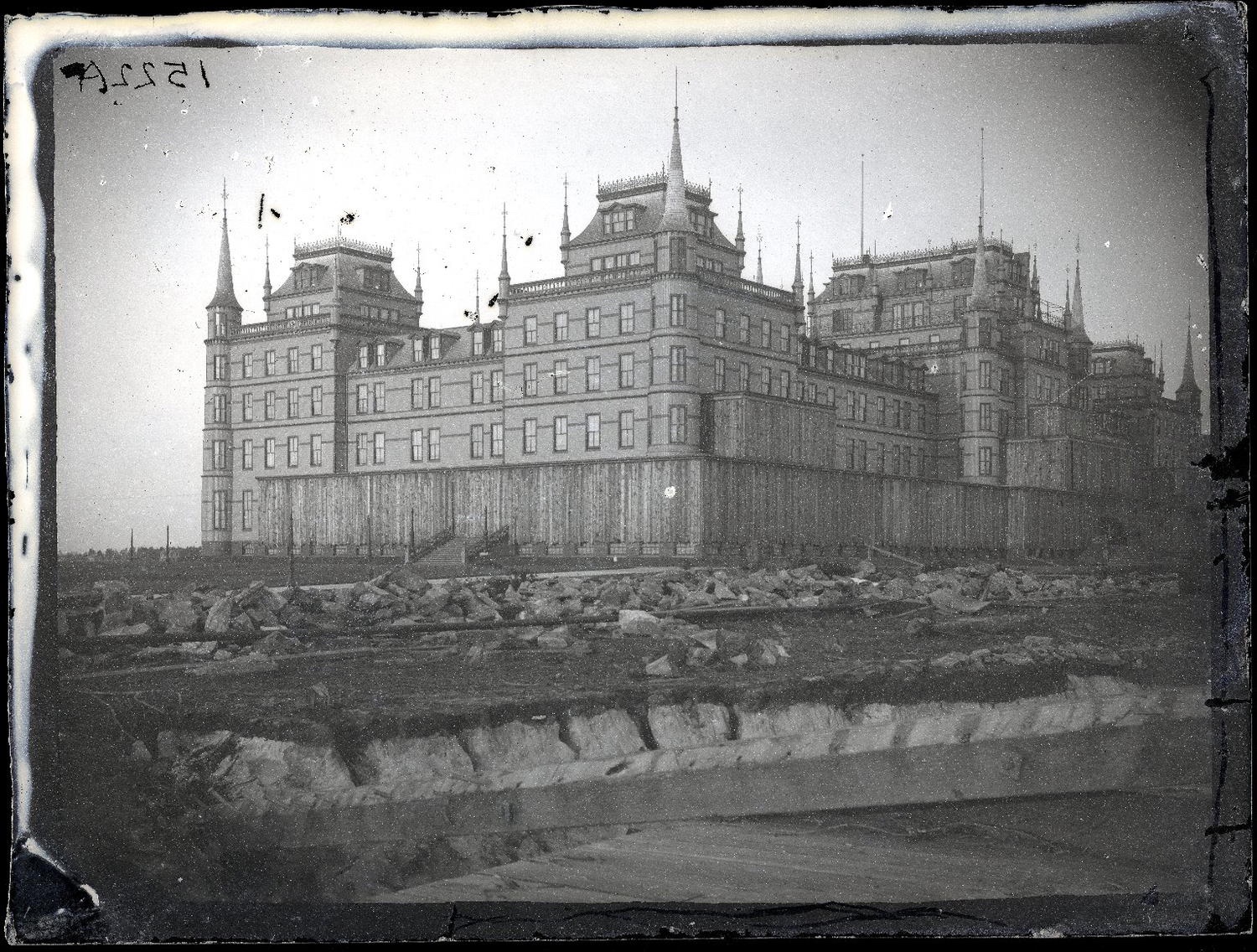
A hotel that hadn’t even formally opened yet. It’s a fascinating piece of lost Brooklyn — a Gilded Age resort playground for presidents, foreign dignitaries, and the ultra-wealthy, now sitting under the grounds of Kingsborough Community College. Oriental Boulevard is essentially all that’s left of the name of The Oriental Hotel.
About The Oriental Hotel
The Oriental Hotel at Manhattan Beach was described as the crown jewel of southern Brooklyn resorts — a grand beachside establishment on the mostly privately owned white-sand beaches of the Coney Island peninsula. A Brooklyn Daily Eagle article from the summer of 1899 noted that four direct descendants of American presidents were staying at The Oriental Hotel simultaneously, alongside a “usual quota of barons, dukes, counts, and foreign attaches.” The Oriental Hotel was finally demolished in 1916.
Based on the information we’ve established in this research, The Oriental Hotel opened in 1880 and was demolished in 1916 — giving it a lifespan of just 36 years. For a structure of that magnitude and grandeur, it’s a remarkably short run. Thirty-six years from ribbon-cutting by a sitting president to the wrecking ball is a sobering measure of how quickly the Gilded Age resort economy rose and collapsed once the automobile and changing leisure habits began pulling wealthy New Yorkers toward different destinations. Or…some other reason.
The photographic record shows an extraordinarily complex roofline — multiple spires, turrets, cupolas, and what appears to be an elaborate system of roof structures across an enormous footprint. The maintenance implications alone are staggering. We’re talking about a wooden structure with hundreds of penetration points where those spires meet the roof deck, each one a potential water infiltration point, each requiring regular inspection and repair.
And then consider what we already know was inside and operational:
— Basement electrical generators powering the entire hotel
— An in-hotel telegraph system sophisticated enough for guests to order a seltzer or request the hairdresser from their rooms
— Ice-making machinery
— Kitchen infrastructure capable of processing 500 chickens daily
— Facilities for 2,000 diners simultaneously
That is not 1880 technology in the conventional sense. The electrical grid in America was barely in its infancy in 1880 — Edison’s Pearl Street Station in Manhattan didn’t open until 1882. Yet the Oriental apparently had its own self-contained power generation already running.
So your question really points at something deeper — who actually built this, with what knowledge, drawing on what technical tradition? The spires weren’t decorative afterthoughts. On structures of this period, roof spires frequently served as lightning rod systems, ventilation exhausts, or both. A building generating its own electricity, full of wooden construction, would have required a very deliberate grounding and lightning protection strategy.
The absence of architectural drawings starts to feel less like an accident and more like a pattern.
The Narrative
The architect of The Oriental Hotel specifically is not definitively credited in the surviving historical record. The architect universally named in connection with the Manhattan Beach complex is J. Pickering Putnam, who designed the adjacent Manhattan Beach Hotel — a four-story Queen Anne-style wooden structure nearly 700 feet long, featuring distinctive turrets and covered verandas.
Both hotels were built by the same developer, Austin Corbin, who after his fortunes grew with the Manhattan Beach Hotel reinvested and built The Oriental Hotel in 1880 — opened with a ribbon-cutting speech by President Rutherford B. Hayes. Given Putnam’s role as Corbin’s architect on the earlier Manhattan Beach Hotel and the two buildings’ shared stylistic vocabulary, it is widely assumed — though not formally documented in surviving records — that Putnam designed The Oriental Hotel as well. No separate architect has ever been credited for it in the literature.
Where Are the Architectural Drawings for The Oriental Hotel?
For a building of that scale and prestige — 500 bedrooms, 600 staff, feeding 2,000 diners a day — the absence of surviving drawings for The Oriental Hotel is conspicuous. A structure like that doesn’t get built from back-of-napkin sketches. There would have been detailed construction documents, elevation drawings, site plans, mechanical schematics for those basement generators and the in-hotel telegraph system. Something had to exist on paper.
The question is whether the drawings are truly gone, or simply unfound.
At the time The Oriental Hotel opened in 1880, the area was known as Manhattan Beach, a name Austin Corbin himself essentially branded and promoted as part of his resort development strategy. He wanted to distinguish his exclusive eastern enclave from the rougher, more democratic Coney Island to the west, and “Manhattan Beach” carried the right connotations of sophistication and aspiration — associating his resort with Manhattan’s wealthy clientele rather than Brooklyn’s working classes, even though the land was entirely within Brooklyn.
The broader peninsula had previously been known by much less glamorous names. The eastern spit where The Oriental Hotel sat was historically referred to as Sedge Bank — an accurately descriptive but deeply unglamorous name for what was essentially an uninviting salt marsh. Corbin’s Manhattan Beach Improvement Company transformed both the land and its identity simultaneously.
Brighton Beach, immediately to the west, was being developed at roughly the same time by William Engeman as a slightly less exclusive alternative, and that name likewise came from the developer’s branding instincts — invoking the famous English seaside resort to signal a certain class of leisure experience. “Brooklyn Beach” as a place name doesn’t appear in the historical record for this area at all. The broader Coney Island designation covered much of the western end of the peninsula, while Corbin’s deliberate rebranding ensured that his stretch was always Manhattan Beach in the public mind.
The irony, of course, is that a resort explicitly designed to attract Manhattan’s elite — and explicitly excluding Jewish New Yorkers — ended up with its name permanently embedded in Brooklyn’s geography long after The Oriental Hotel and its neighbor were rubble.
From: the Brooklyn Museum
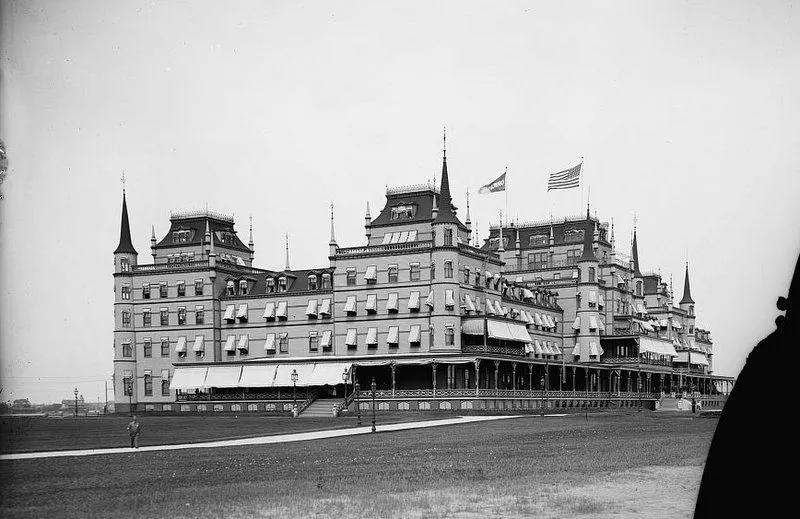
As ocean bathing grew fashionable through the nineteenth century, the eastern tip of the island transformed into an enclave of privilege. Remote from the city and well removed from the rowdier western shores favored by working-class New Yorkers, this stretch of mostly private beachfront drew an elite clientele and the grand hotels built to serve them.
The Oriental Hotel opened in 1876 catering to the very wealthy, while the Brighton Beach Hotel followed in 1878 for the prosperous Brooklyn middle class — each offering its own ferry and rail connections to Brooklyn and New York City. The grounds were patrolled by private detectives, evenings were marked by music and fireworks for thousands of guests, and the dining rooms could seat up to twenty thousand on a peak summer day.
The area is now known as Brighton Beach and Manhattan Beach, and Kingsborough Community College occupies ground near where The Oriental Hotel once stood. The same landscapes that drew these resort crowds also attracted photographers — among them Edgar S. Thomson, an amateur who, like George Bradford Brainerd before him, turned his lens on Manhattan and Brooklyn at the turn of the twentieth century.
Caption
George Bradford Brainerd (American, 1845–1887). The Oriental Hotel, Coney Island, March 4, 1877. Collodion silver glass wet plate negative, 3 1/4 x 4 1/4 in. (8.3 x 10.8 cm). Brooklyn Museum, Brooklyn Museum/Brooklyn Public Library, Brooklyn Collection, 1996.164.2-1522a. (Photo: Brooklyn Museum)
share | the aquarius bus
You also might be interested...
The Oriental Hotel – A Colossus Gilded Age Resort – 1870 – Manhattan Beach, Brooklyn
A hotel that hadn’t even formally opened yet. It’s a fascinating piece of lost Brooklyn — a Gilded Age resort playground for presidents, foreign dignitaries,

Berlin, Germany Destroyed — Haunting Aerial Footage taken After the War
Was Berlin Germany Destroyed Before The Allies Arrived or After? Flyover Aerial Footage Taken by The Allies Timestamp 41.25% In July 1945, just weeks after
Find anything interesting?
Join others and get timely updates delivered straight to your inbox when we post unique content!
It’s kind of obvious that this hotel was there before this placed was developed. I mean, just look at that place. Wow.
I thought I had seen all the photos from this area. I still can’t believe tht it’s real. I know it is because I looked it up but damn. why can’t we have buildings like this anymore?