
Berlin, Germany Destroyed — Haunting Aerial Footage taken After the War
Was Berlin Germany Destroyed Before The Allies Arrived or After?
In July 1945, just weeks after Germany’s unconditional surrender, the Western Allies finally rolled into Berlin, Germany destroyed. What they found was staggering: a city in ruins, carved into occupation sectors, and firmly under Soviet control. This premium documentary uses rare, high-quality color footage and first-hand accounts to show what daily life looked like inside the destroyed capital. From the backbreaking labor of the Trümmerfrauen — the “rubble women” who cleared the wreckage by hand — to the simmering political tensions at the Potsdam Conference, the film traces how the first seeds of the Cold War were quietly sown in the ashes of the Third Reich.
To understand the footage you’re about to see, it helps to know how Berlin Germany destroyed itself — or, more accurately, how it was destroyed. The devastation came in two overlapping waves. The first was years of relentless Allied strategic bombing. Beginning in earnest in 1943 and intensifying through 1944 and early 1945, British RAF night raids and US Army Air Forces (USAAF) daylight raids pounded the capital’s industry, rail yards, and government quarter. The second wave was the Battle of Berlin itself in April and May 1945, when the Red Army fought its way through the city street by street, block by block, with artillery and tank fire finishing off what the bombers had begun. By the time the guns fell silent, Berlin was one of the most thoroughly ruined major cities on Earth. Berlin, Germany Destroyed.
At this point in the film, the USAAF flyover footage gives you something no ground-level photograph ever could: scale. From the air, the damage stops being a collection of broken buildings and becomes a continuous landscape of devastation — hollowed-out blocks, roofless rows, and the gray haze of pulverized masonry stretching to the horizon. It’s the single clearest answer to the question so many viewers ask: just how completely was Berlin Germany destroyed?
The Bottom-Line Answer
Out of roughly 410,000–420,000 pre-war buildings in Berlin (within the 1920 boundaries), only about 50,000–60,000 (12–15%) were still fully or almost fully intact and immediately habitable when the Red Army entered the city in May 1945.
Another ~150,000–180,000 buildings were standing but needed major repairs — new roofs, windows, wiring, plumbing, and more. The remaining 20–22% were total losses that had to be demolished in the late 1940s and 1950s. Those demolitions are where the famous Trümmerberge, or “rubble mountains,” came from: artificial hills built from the crushed remains of the city, several of which still rise above Berlin’s parks today as green monuments to the scale of the destruction.
Visual Reference (1945–1946 Allied & Soviet estimates)
• Central districts (Mitte, Tiergarten, Friedrichshain, Kreuzberg): 70–95% of buildings destroyed or heavily damaged. These were the heart of the Nazi state and the final battleground, so they took the worst of both the bombs and the ground fighting.
• Inner-ring districts (Prenzlauer Berg, Wedding, Charlottenburg): 50–75% destroyed or heavily damaged.
• Outer suburbs: often less than 30% destroyed, with many houses left standing and intact.
So while Berlin was not “100% flattened,” as is sometimes claimed, the reality is sobering: 85–88% of its buildings were either destroyed outright or required major reconstruction. Only a small fraction — roughly one in every seven or eight — came through the war essentially unscathed.
Why the Destruction Mattered Beyond the Rubble
The physical ruin tells only half the story. When the Western Allies arrived in July 1945, they inherited a humanitarian emergency layered on top of the wreckage. Hundreds of thousands of Berliners were living in cellars and partial shells of buildings. Clean water, electricity, and food were scarce, and the coming winter would prove brutal. The Trümmerfrauen became the enduring symbol of this period — women who, with little more than buckets and bare hands, salvaged and stacked usable bricks so the city could begin to rebuild.
But Berlin Germany destroyed was about more than masonry. The city’s four-power division — American, British, French, and Soviet sectors sitting deep inside the Soviet occupation zone — turned the ruined capital into the front line of a new global standoff almost overnight. The cooperation on display at Potsdam was already fraying. Within three years, those same streets would witness the Berlin Blockade and the Airlift; within sixteen, the Wall. The destroyed capital didn’t just mark the end of one war — it became the stage on which the next half-century of geopolitical conflict would play out.
That’s the quiet power of the aerial footage at [41:25]. It captures a single frozen moment — a city at the absolute bottom — sitting precisely on the hinge between the war that flattened it and the Cold War it was about to define. The footage literally shows an Old World City, totally obliterated: Berlin, Germany Destroyed.
A mental comparison of the size of Berlin Germany Destroyed in 1945
Here’s the stats for NYC (and the 5 boroughs) + Berlin, Germany – both statistics are compared for 1945.
New York City
302.6 sq mi
784 km²
Five boroughs (Manhattan, Brooklyn, Queens, Bronx, Staten Island)
Berlin (1945 and today)
341 sq mi
883 km²
Identical boundaries since 1920
The number of bombers and munitions that hit Berlin_
RAF Bomber Command (1940–1945)
~20,000 sorties (mostly night raids)
~45,000–50,000 tons
4–7 tons (Lancaster ~7 tons, Halifax ~6 tons, earlier types less)
USAAF 8th & 15th Air Forces (1943–1945)
~16,000 sorties (daylight precision raids)
~22,000–25,000 tons
2–5 tons (B-17 ~2–4 tons, B-24 ~4 tons typical over Berlin)
Soviet Air Force (Apr–May 1945)
~1,500–2,000 sorties
~3,000 tons
1–3 tons
Total Allied bombers that attacked Berlin
Berlin Germany Destroyed SOURCE:
@WarStoriesChannel
share | the aquarius bus
You also might be interested...
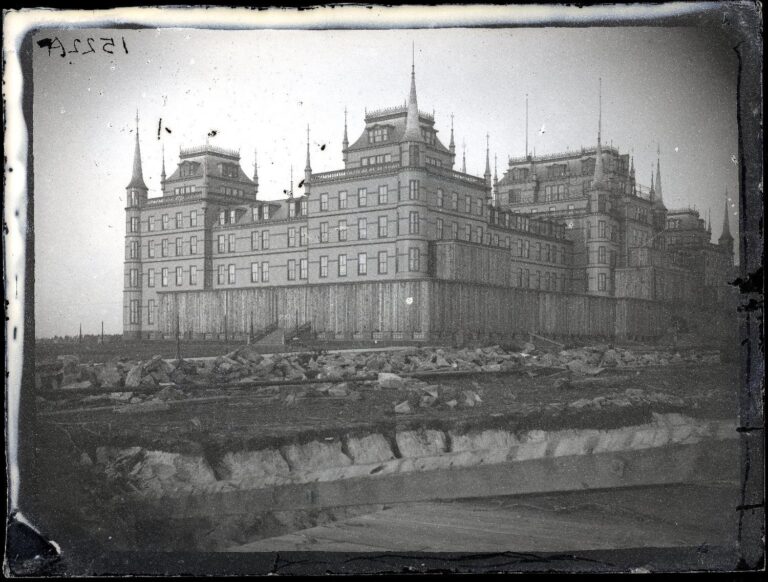
The Oriental Hotel – A Colossus Gilded Age Resort – 1870 – Manhattan Beach, Brooklyn
A hotel that hadn’t even formally opened yet. It’s a fascinating piece of lost Brooklyn — a Gilded Age resort playground for presidents, foreign dignitaries,

Berlin, Germany Destroyed — Haunting Aerial Footage taken After the War
Was Berlin Germany Destroyed Before The Allies Arrived or After? Flyover Aerial Footage Taken by The Allies Timestamp 41.25% In July 1945, just weeks after
Find anything interesting?
Join others and get timely updates delivered straight to your inbox when we post unique content!
All I can say is that the destruction did not warrant the mission. Incredible footage.